


SUV e-bike explained
What is an SUV e-bike? This article explains everything about its features, uses, and how it differs from e-MTBs and trekking bikes—plus tips on costs, choosing the right one, and leasing.
The most important points at a glance.
An SUV e-bike is a crossover concept: a mountain bike frame and powerful motor combined with the everyday features of a touring bike.
There is no standardized definition: depending on the manufacturer, the model may be closer to an e-mountain bike or closer to a touring bike.
Powerful setup: Typical specifications include 75 to 120 Nm of torque, batteries starting at 600 Wh, suspension travel of 100 to 150 millimeters, and a weight of 24 to 30 kilograms.
Robust components: Lights, fenders, a rack, and a kickstand are factory-installed, making the bike StVZO-compliant out of the box.
All-rounder: Its strength lies on mixed terrain, while its weakness is on long-distance rides on asphalt alone.
SUV e-bikes are often premium e-bikes: In terms of price, SUV models are usually above the market average, which makes company bike leasing particularly relevant for this category.
The ride to the office, the weekly grocery run, the dirt road on the outskirts of town, and the Sunday ride - an SUV e-bike is designed to handle it all. The term is borrowed from the automotive world—SUV stands for Sport Utility Vehicle - and to this day, there is no official technical definition for it. Nevertheless, the concept has become a staple in the lineups of nearly all major manufacturers. In the following, we’ll explain what characteristics define an SUV e-bike, how it differs from a trekking bike and an e-mountain bike, what types of terrain it’s actually suited for, and what you should keep in mind when choosing and leasing one.
What is an SUV e-bike?
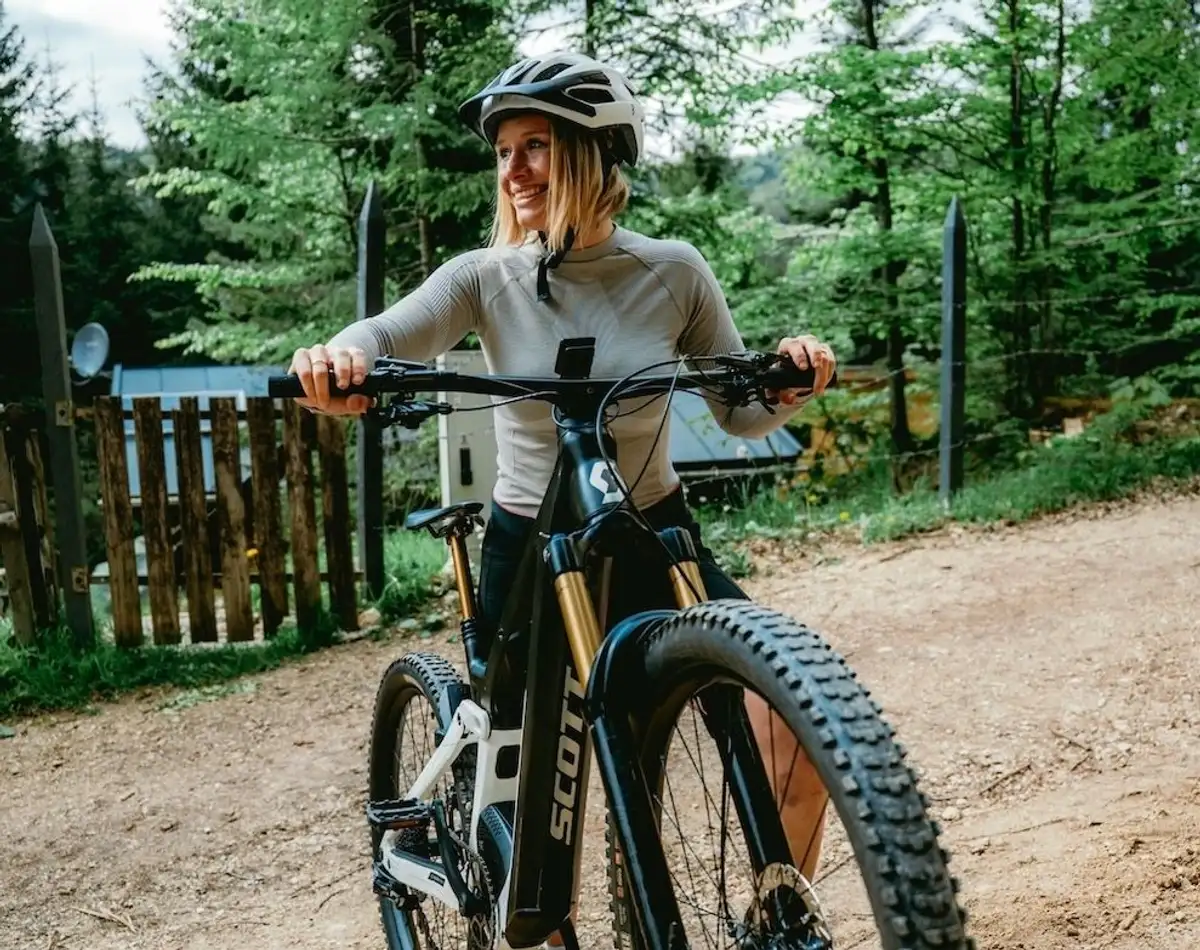
Essentially, an SUV e-bike is an electrically assisted bicycle that combines the rugged construction and powerful drive of an e-mountain bike with the everyday features of a trekking or city bike. In most cases, the frame is based on that of a mountain bike or touring bike. Manufacturers then mount fenders, a rack, a permanently installed lighting system, and a side stand. The handlebars are positioned slightly higher than on a sporty e-MTB—thanks to spacer rings or a steeper stem—resulting in a moderately sporty, slightly forward-leaning riding position.
The emphasis placed on each of these features varies significantly from brand to brand. Some models are practically fully equipped e-mountain bikes with full suspension and knobby tires, while others resemble heavily outfitted trekking bikes with suspension forks and wider tires. There is no uniform standard, which is why looking at the specific technical details is more important than the category label in the brochure.
Good to know: Legally, the same rules apply to SUV e-bikes as to all pedelecs. Motor assistance cuts off at 25 km/h, and the maximum continuous power output is 250 watts. This means that, according to Section 1(3) of the German Road Traffic Act (StVG), they are classified as bicycles—with no helmet requirement, no insurance sticker, and the right to use bike paths.
Typical features of an SUV e-bike
Powerful mid-drive motor: Torque ranging from 75 to 120 Nm provides plenty of power on inclines and when carrying heavy loads.
Large battery capacity: 600 to 800 Wh is standard, sometimes with the option of a second battery.
Suspension: A suspension fork with 100 to 150 millimeters of travel; full-suspension models also feature a rear shock absorber.
Wide Tires with Tread: 2.2- to 2.6-inch-wide tires with a light lug pattern provide traction on gravel, grass, and wet roots.
Full StVZO Equipment from the Factory: Lights, fenders, a rack, a kickstand, and a bell are installed; no modifications are necessary.
High Payload Capacity: Permitted gross weights ranging from 140 to 170 kilograms allow for luggage, groceries, or a child seat.
Hydraulic Disc Brakes: Typically equipped with larger brake rotors than those found on trekking bikes, due to the bike’s higher system weight and speed.
SUV e-bikes: Not (yet) an official bicycle category.
The German e-bike market has become highly diversified. According to market data from the “Bicycle Industry 2025” report by the industry association ZIV – Die Fahrradindustrie, approximately two million e-bikes were sold in the past fiscal year, accounting for 52.7 percent of the total market. Within this segment, e-mountain bikes dominate with 38 percent, followed by e-trekking bikes with 24 percent, e-city bikes with 19 percent, and e-cargo bikes with 9.5 percent. The e-ATB category - that is, electrically assisted all-terrain bikes - grew from 3.5 to 5 percent.
What is notable is what is missing from this breakdown: the SUV e-bike does not appear in any official statistics as a separate model group. Depending on its design, it is classified as an e-mountain bike, an e-trekking bike, or an e-ATB. This accurately describes the category - it is an intersection of categories, not a distinct type of bike. Price trends are also relevant: In 2025, the average retail price of an e-bike across all sales channels was 2,550 euros, whereas in quality-oriented specialty stores it was 3,972 euros. With their full range of features and powerful drives, SUV models regularly fall within this higher price range or above it.
SUV e-bike, trekking e-bike, or e-mountain bike: The differences.
The three categories overlap, but each has a clearly distinct focus. The trekking bike is designed for efficiency and long distances, while the e-mountain bike is designed for control on rough terrain. The SUV e-bike falls somewhere in between and deliberately accepts certain compromises to achieve this. The following overview highlights the differences in technology, features, and intended use.
SUV e-bike
Frame type: MTB frame with everyday components
Riding position: moderately sporty, upright
Suspension: 100–150 mm, hardtail or full-suspension
Tires: 2.2–2.6” with a light tread pattern
Specs: Fully compliant with StVZO regulations from the factory
Weight: 24–30 kg
Torque: 75–120 Nm
Range: 50–110 km
Usage: Road, gravel, forest trails, light terrain
Price range: €3,500–8,000
Trekking e-bike
Frame type: Trekking/cross frame
Riding position: touring-oriented, efficient
Suspension: 60–100 mm, some models with rigid fork
Tires: 40–55 mm, low rolling resistance
Equipment: Fully compliant with StVZO regulations from the factory
Weight: 22–28 kg
Torque: 50–85 Nm
Range: 60–140 km
Intended use: Paved roads, bike paths, paved farm roads
Price range: €2,500–6,000
E-mountain bike
Frame type: MTB frame
Riding position: sporty, leaning forward
Suspension: 120–180 mm, usually full-suspension
Tires: 2.4–2.6” with deep tread
Equipment: no lights, fenders, or rack
Weight: 16–26 kg
Torque: 85–150 Nm
Range: 50–120 km
Usage: Trails, off-road, bike park
Price range: €2,500–10,000
Where the SUV e-bike excels: Wide tires and suspension travel smooth out potholes, cobblestones, and tree roots, the powerful motor handles cargo even uphill, and the sturdy frame construction ensures a smooth ride despite the bike’s higher overall weight. Those who ride year-round also benefit from the grip in wet conditions and on leaves.
Where the SUV e-bike falls short: An SUV e-bike often weighs four to five kilograms more than a comparable trekking e-bike. The tires roll with more resistance, and this becomes noticeably apparent once you exceed the 25 km/h assist limit. On long paved stretches, for example, a trekking e-bike with the same battery capacity will take you farther. Conversely, if you’re riding truly technical trails, you’re better off with an e-mountain bike without a rack or long fenders.

Who would benefit from an SUV e-bike?
This category isn’t aimed at a specific target audience. Instead, it caters to a particular usage pattern: People who regularly switch between very different types of terrain are better off riding an SUV e-bike than a specialized model. This scenario is more common than it might seem at first. According to the study “Mobility in Germany” by the Federal Ministry of Transport, e-bike riders cover an average of 6.3 kilometers per trip, compared to 3.7 kilometers for riders of non-motorized bicycles. The motor extends the rider’s range—and thus the likelihood that a route will not be paved throughout.
Specifically, an SUV e-bike really shines in these situations:
Commute with mixed terrain: bike paths, farm roads, gravel sections, and wooded areas all along the same route.
Rural areas: poorly maintained side roads, dirt roads, and gravel paths.
Shopping and transport: high payload capacity thanks to panniers, a basket, or a child seat, without compromising handling stability.
Weekend tours: forest trails and moderate climbs, without having to remove fenders and a rack beforehand.
Year-round use: wet conditions, leaves, gravel, and frost require traction and durable components.
Higher system weight: Taller or heavier riders benefit from the frame’s stiffness and high load-carrying capacity.
Buying an SUV e-bike: Six factors that make all the difference.
Because this category is so broad from a technical standpoint, the specific configuration determines whether the bike is a good fit for your riding profile. The following six points will help you narrow down your options.
Define the job profile honestly
Keep track of your actual routes during a typical week, noting the distance and surface type. If the proportion of gravel and forest trails is less than 10 percent, a trekking e-bike is often sufficient. If, on the other hand, the surface types change several times per ride, the SUV-style bike is the right choice.
Tuning the engine and torque
Torque comes in handy when you’re facing both an incline and a heavy load. For hilly terrain with luggage, 85 Nm or more is recommended. For flat to gently undulating routes, 75 Nm is sufficient. More important than the peak value is how the system is tuned: A drive system that delivers power smoothly makes it easier to pull away from traffic lights and maneuver on loose surfaces.
Link battery capacity to realistic distances
Estimate the longest distance you plan to ride without stopping to charge, and when calculating range for an SUV e-bike, factor in a reduction compared to the manufacturer’s specifications. Good to know: Weight, wide tires, and cargo increase energy consumption. For commutes of up to 20 kilometers each way, 600 Wh is usually sufficient. For day trips with elevation gain, 750 Wh or a second-battery option is the safer choice.
Choosing between a hardtail and a full-suspension bike
Both variants are available in this category and are designed for different riding styles.
Hardtail SUV: Front suspension only, making it lighter, lower-maintenance, and more affordable. Power transfer is more direct, and the rack is mounted directly to the frame, providing greater stability. Suitable for commutes, farm roads, and occasional forest trails.
Full-Suspension SUV: Front and rear suspension, offering more comfort and traction on roots, gravel, and long descents. However, it’s heavier, requires more maintenance on the shock absorber, and often features a rack mounted on the seatpost or rear triangle with a lower load capacity. Suitable for challenging terrain and long tours.
Check the maximum allowable weight
The maximum allowable weight includes the bicycle, the rider, and luggage. With a bike weight of 28 kilograms and a limit of 150 kilograms, that leaves 122 kilograms for the rider and cargo. Also check the maximum load capacity of the rack - it ranges from 18 to 27 kilograms depending on the design and is often lower on full-suspension bikes.
Adjusting ergonomics and frame size
With a bike of this weight, your riding position and frame size have a greater impact than they do with a lightweight city bike. Pay attention to the ground clearance, reach to the handlebars, and step-through height. It’s worth getting a professional riding position analysis at a specialty bike shop - especially if you commute daily.
Leasing an SUV e-bike: Costs, term, and tax benefits.
With prices ranging from 3,500 to 8,000 euros, SUV e-bikes are significantly above the market average. Employer-sponsored bike leasing is therefore particularly attractive for this price range. Since the leasing payment is deducted from your gross salary through payroll deduction, your income tax and social security contributions are reduced. Depending on your income and tax bracket, leasing can be up to 40 percent cheaper than buying outright - and the absolute savings increase as the bike’s price rises. You can find a detailed comparison of the pros and cons in our article on whether bike leasing is really worth it.
The tax basis is the 0.25 percent rule: The monetary benefit from personal use is calculated as 0.25 percent of the manufacturer’s suggested retail price, rounded down to the nearest 100 euros (Section 8(2) of the Income Tax Act (EStG), Federal Ministry of Finance (BMF) letter dated January 9, 2020). The standard lease term is 36 months. After that, you can purchase the bike at a residual value of typically 15 to 18 percent, return it, or lease a new company bike. We’ve summarized exactly what happens at the end of the lease term in a separate article.
By the way: Specialty retailers play an important role in this category. SUV e-bikes require proper initial assembly, appropriate suspension tuning, and regular inspections - with a system weight of 28 kilograms and off-road use, brake pads, chains, and tires wear out faster than on a city bike.
Conclusion: Not the best bike, but a versatile one.
This overview shows that the SUV e-bike isn’t an improvement over a trekking bike or an e-mountain bike - it’s simply more versatile. To achieve this, it sacrifices the efficiency of one and the off-road capability of the other, thereby gaining reserves, durability, and year-round usability. This approach pays off if your riding routes actually vary - but it doesn’t work if 95 percent of your kilometers are on pavement. Anyone choosing this category should therefore focus less on the label and more on the configuration: torque, battery capacity, suspension design, payload, and tire choice determine whether this two-wheeled all-rounder is a good fit for everyday use.