


E-city bike explained
What is an e-city bike? This article explains everything about different models, features, and using them in city traffic—plus tips on leasing an e-city bike.
The most important points at a glance.
An e-city bike is an everyday bike with pedal assistance up to 25 km/h, designed for short- to medium-distance urban travel.
Accounting for 19 percent of e-bike sales, e-city bikes are the third-largest segment in Germany.
Typical features include an upright riding position, a low step-through frame, and full equipment in accordance with the StVZO (German Road Traffic Regulations), including lights, fenders, a rack, and a kickstand.
Low-maintenance hub or gear-based drivetrains with belt drives are particularly common in the city.
For city use, everyday practicality, visibility, and theft protection matter more than maximum motor power or battery capacity.
Through providers like Lease a Bike, an e-city bike can be leased as a company bike—including comprehensive coverage and a mobility guarantee.
It’s five kilometers to work. By car, that means traffic jams on the main road and then hunting for a parking spot. By train, waiting, transferring, and the walk to the station cause stress. By bike, on the other hand, you can just set off and arrive. In fact, the bicycle is usually the fastest mode of transportation for short urban trips. This is especially true with an e-bike. The motor makes hills easier, compensates for headwinds, and even makes two full shopping bags on the rack a non-issue.
As its name suggests, the e-city bike is perfectly tailored to the needs of urban cycling. It’s not a sports bike—nor does it aim to be one—but rather an everyday vehicle that works every day—in the rain, in the dark, with a bag on the rack. The following overview shows what makes this bike special, what models are available, and what features are essential for city riding.
Statistics: City e-bikes in the bicycle market.
A look at the market confirms the importance of the city e-bike category: According to the latest market data from the industry association ZIV – The Bicycle Industry, e-city bikes accounted for 19 percent of all e-bikes sold in Germany in 2025. This puts the segment in third place behind e-mountain bikes (38 percent) and e-trekking bikes (24 percent)—and it remains remarkably stable because it is driven less by leisure trends and more by the daily commute to work.
What is an e-city bike?
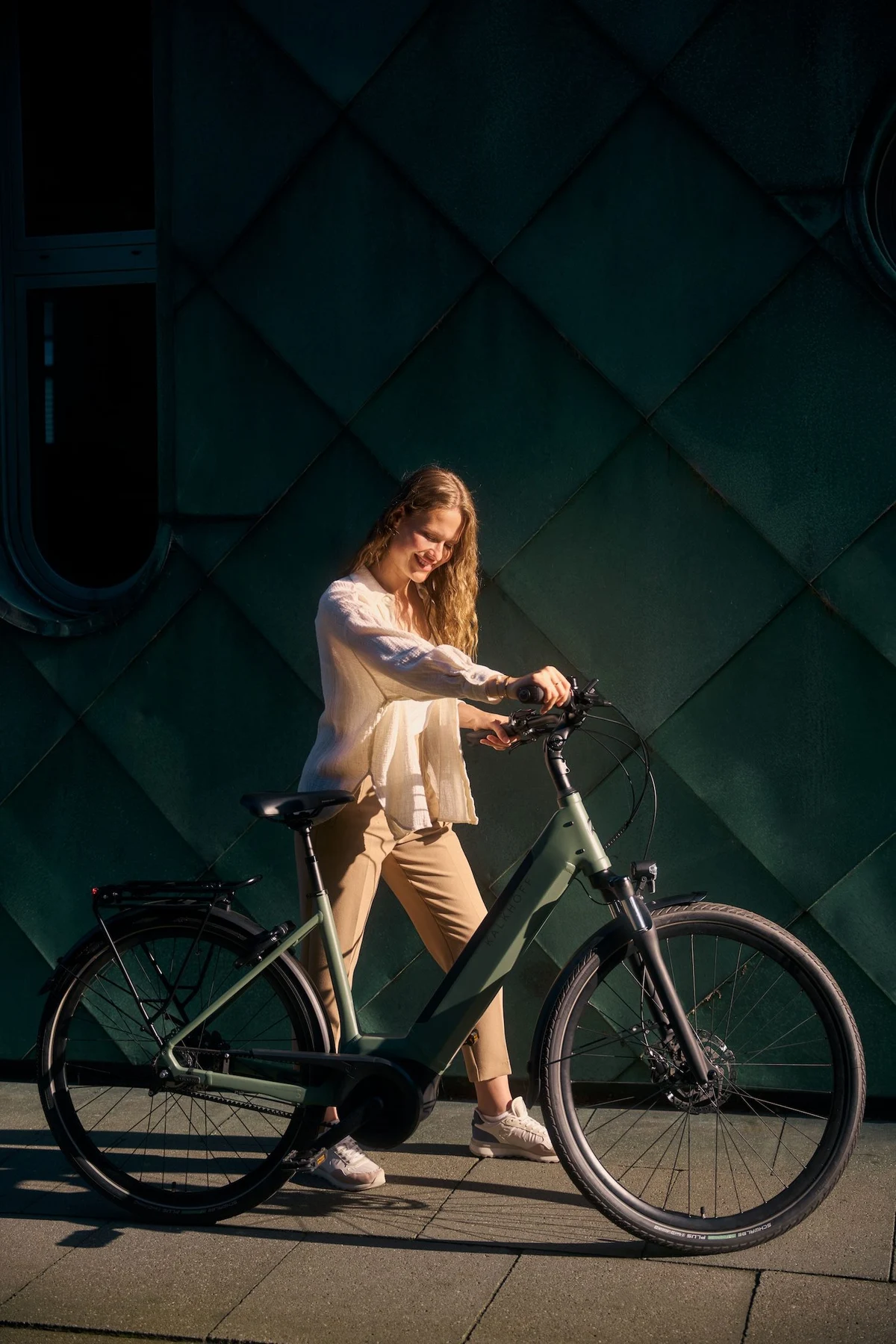
An e-city bike is a pedelec designed for everyday urban use. As with any e-bike, the motor assists pedaling up to 25 km/h. Legally, the bike is classified as a bicycle—meaning you don’t need a driver’s license or an insurance sticker. In terms of design, it differs from sporty e-bikes primarily in its geometry: the handlebars are higher, the seating position is upright, and this provides a better view of traffic. Instead of maximum efficiency, the focus is on comfort, visibility, and practicality.
Typical features of a city e-bike include:
Upright geometry: High handlebars and a short reach reduce strain on the wrists and neck and improve visibility in traffic.
Low step-through: Wave or trapezoidal frames make it easier to get on and off the bike. This is helpful at traffic lights, when wearing a skirt, or when using a child seat.
Fully equipped according to StVZO: Permanently mounted lights with parking lights, fenders, a rack, a kickstand, and a bell are included as standard equipment.
Low-maintenance drivetrain: Hub or gear shifters are often standard and are frequently combined with a belt drive instead of a chain.
Comfort features: Wide tires with puncture protection, suspension seatposts or short-travel suspension forks, and ergonomic grips are often part of the standard equipment.
Moderate battery capacities: Usually 400 to 625 Wh. This is sufficient for several days of city riding without needing to recharge.
E-city bike vs. e-trekking bike vs. e-mountain bike: Here are the differences.
The three best-selling e-bike categories overlap in terms of technology but differ significantly in design and intended use. For example, someone who rides only in urban areas would be buying an e-MTB with suspension travel and weight that offer no practical benefit in everyday use—while also forgoing fenders and a rack. The following overview highlights the differences:
E-city bike
Intended use: City riding, commuting, shopping
Riding position: Upright
Tire width: 40–55 mm, puncture-resistant
Suspension: seatpost or short-travel fork
StVZO compliance: fully compliant as standard
Gear system: hub or derailleur gears
Battery: 400–625 Wh
Weight: 22–28 kg
Price: approx. €1,800–4,000
E-trekking bike
Usage: Everyday riding, touring, bike trips
Riding position: Slightly stretched
Tire width: 40–50 mm, treaded
Suspension: Suspension fork, 50–80 mm
StVZO compliance: Fully compliant as standard
Gear system: Derailleur or hub gears
Battery: 500–800 Wh
Weight: 22–27 kg
Price: approx. 2,300–6,000 €
E-mountain bike
Intended Use: Trails, Off-Road, Mountains
Riding Position: Sporty, Active
Tire Width: 55–65 mm, deep tread
Suspension: 100–180 mm, often full suspension
StVZO-compliant equipment: usually not included
Gear system: derailleur
Battery: 600–800 Wh
Weight: 20–26 kg
Price: approx. €3,000–10,000

These are the types of e-city bikes and their intended uses.
There are also significant differences even within the “city” category. Someone who commutes 12 kilometers a day on main roads needs a different bike than someone who takes two children to daycare or combines biking with train travel. These options have become standard:
Classic e-city bike – the comfortable low-step model
The most common model: low step-through frame, high handlebars, wide saddle, and a full set of everyday features. Designed for a relaxed pace and rides of up to about 15 kilometers. Ideal for shopping, short commutes, and anyone who values the ease of getting on and off the bike.
Urban or commuter e-bike – streamlined and ideal for commuting
With a sportier, sleeker design, often featuring diamond or trapezoidal frames, belt drives, and integrated lighting. These bikes are designed for daily commutes of 10 to 25 kilometers and combine brisk speed with practical features for everyday use. They often incorporate lightweight hub motors that operate particularly quietly.
E-compact and e-folding bikes – for short trips and tight spaces
With 20-inch wheels and a short wheelbase, compact bikes are maneuverable and space-saving. Folding bikes can also be taken on trains, buses, or in cars, making them a convenient solution for the first and last mile of a longer commute. For small apartments without basement storage, this design is often the only practical solution.
SUV and cross e-bikes – When the city gets rough
Cobblestones, construction zones, lowered curbs—plus a gravel path along the river on the weekend: That’s what sturdier city bikes with wider tires, suspension forks, and more powerful motors are designed for. They’re heavier than classic city bikes, but they’re more resilient on rough terrain.
Electric cargo bike – transportation without a car
As soon as you start regularly transporting children or larger purchases, a regular bike rack reaches its limits. E-cargo bikes remain almost as maneuverable as a regular bike, but offer space for child seats or panniers. Learn more about e-cargo bikes here.
S-Pedelec: The ideal solution for long commutes.
Anyone who commutes more than 20 kilometers daily from the suburbs into the city will hit a limit at 25 km/h. S-pedelecs can reach speeds of up to 45 km/h but are classified as mopeds. This means that an insurance plate, a helmet, and an AM driver’s license are required, and riders are generally not allowed to use bike lanes. This is rarely the right choice for everyday inner-city travel. You can find more information about S-pedelecs here.
An overview of e-city bike models.
Type | Ideal for | Strengths | Limitations |
Classic e-city bike | Trips up to 15 km, shopping | Comfort and Easy Access | not very athletic |
Urban-/Commuter e-bike | Commuting 10–25 km | fast, low-maintenance, quiet | often without suspension |
E-compact-/E-folding bike | Commuting by train, limited parking space | space-saving, portable | Smaller batteries, jerky handling |
SUV-/Cross e-bike | Poor roads, mixed-use | Sturdy and versatile | greater weight |
E-Longtail/Compact cargo bike | Kids, big shopping trips | replaces car trips | Parking Space Requirements, Price |
S-Pedelec | Commuting more than 20 km | Speed up to 45 km/h | Helmet, License Plate, Requirement to Drive on the Road |
Features that matter in city driving.
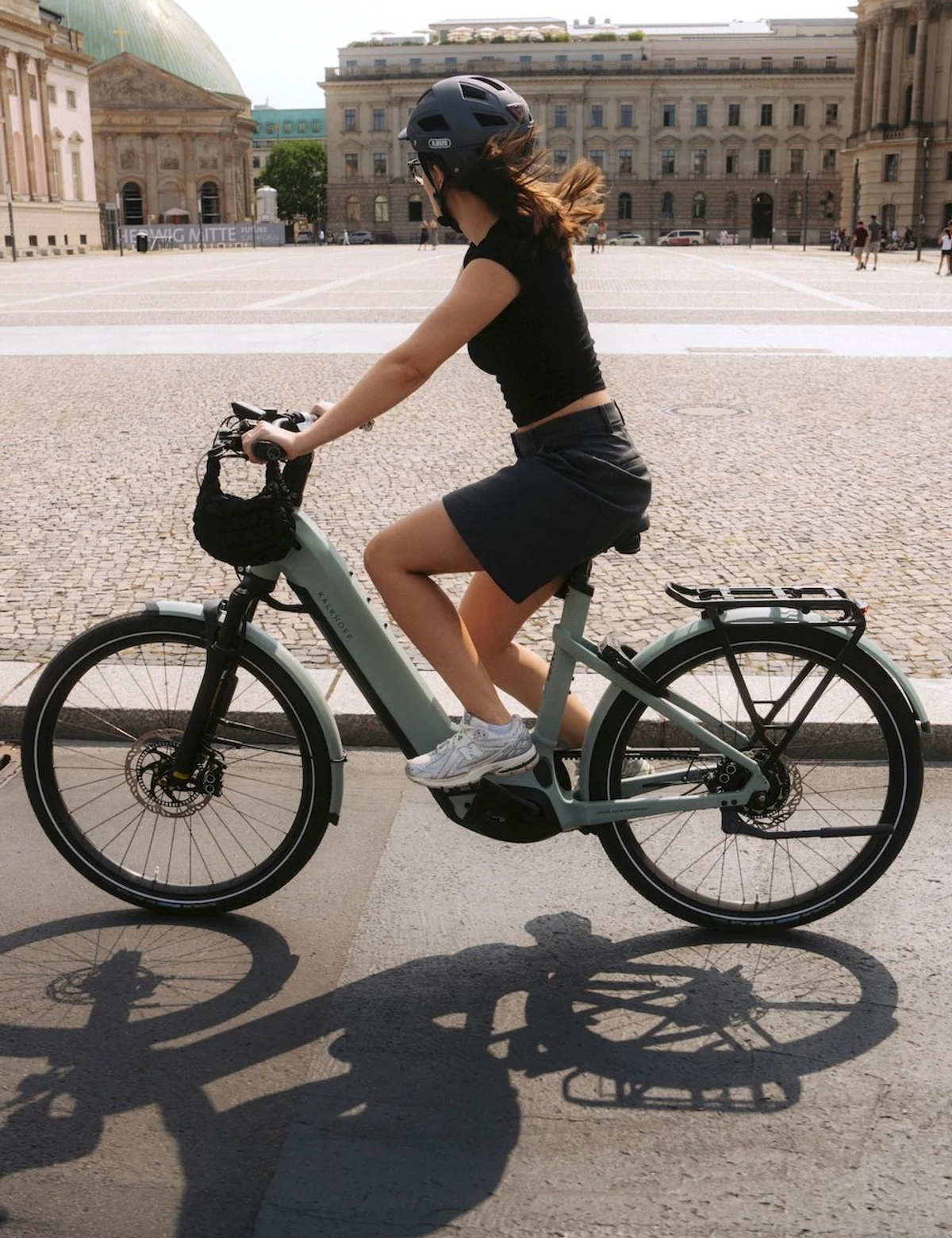
In city traffic, it’s not torque and watt-hours that determine a bike’s suitability for everyday use, but rather the details that come into play on a daily basis. Four points are particularly relevant.
Visibility and Lighting: A permanently installed lighting system with at least 70 lux, parking lights, and brake lights is the most important safety factor in the fall and winter. Reflective tire sidewalls significantly increase side visibility at intersections.
Drivetrain and Maintenance: Hub and gear-based drivetrains with belt drives are virtually maintenance-free, resistant to dirt, and allow shifting while stationary—a noticeable advantage at traffic lights. Chain drivetrains are lighter and less expensive, but require regular maintenance.
Tires and Brakes: Wide tires measuring 40 to 55 millimeters with puncture-resistant liners absorb the impact of cobblestones and reduce the risk of flat tires. Hydraulic disc brakes offer a clear advantage over rim brakes in wet conditions and when carrying a load.
Cargo solutions: A rack mounted to the frame carries significantly more than a handlebar bag and has less impact on handling. Modular racks with quick-release mounts save time in everyday use.
Theft protection: The most important consideration in the city. E-bikes are high-value vehicles and, according to police crime statistics from the Federal Criminal Police Office, are often targeted for theft. Two high-quality locks of different designs, a secure attachment point, a recorded frame number, and a unique code significantly reduce the risk. Many drive systems also offer app-based tracking or an electronic immobilizer.
Buying an e-city bike: Seven steps to finding the right city bike.
There are many options to choose from, and the differences often lie in the details. These seven steps provide a structured approach to making the right decision.
Determine the area of application and route profile
For one week, keep track of the routes you actually ride—distance, surface, elevation gain, and load. For trips under ten kilometers, a standard e-city bike with a medium-capacity battery is more than enough. Only for distances longer than that is it worth considering commuter or trekking models.
Select frame shape and entry point
Wave frames offer the lowest step-through height, trapezoidal frames strike a balance between comfort and stiffness, and diamond frames provide the sportiest design. If you frequently ride with a child seat or heavy luggage, be sure to check the maximum load capacity—which ranges from 120 to 170 kilograms, depending on the model.
Determine the engine position
Mid-engine vehicles are the right choice for hills and heavy loads. Rear-engine vehicles accelerate effortlessly on flat terrain, operate very quietly, and are gentle on the powertrain—ideal for flat cities.
Check the battery and charging status
More important than maximum capacity is where you charge the bike. A removable battery is a must if the bike is stored in a basement, backyard, or bike rack without a power outlet. For typical city use, 400 to 500 Wh is enough to last several days.
Weigh the pros and cons of installation and maintenance costs
Riders who use their bikes daily and in all kinds of weather will benefit from a hub gear system with a belt drive. It requires no chain lube, experiences minimal wear, and has significantly longer service intervals. For more athletic riding or hilly terrain, a derailleur system remains the better choice.
Plan for parking and security
Before buying, consider where the bike will be parked during the day and at night. A frame lock is convenient, but it’s no substitute for a U-lock or chain lock for securing the bike. Factor 100 to 200 euros for high-quality locks into your overall budget.
Review budget, leasing, and service partners
Good e-city bikes start at around 1,800 euros; fully equipped models with belt drives range from 2,800 to 4,000 euros. With a company bike leasing plan, this translates into a predictable monthly payment. Also, make sure there’s a specialized repair shop nearby that services the specific drive system.
Lease an e-city bike with Lease a Bike: The smart alternative.
City bike leasing really shines in urban areas, because the bike is typically used every day and the service component is therefore particularly valuable. Through payroll deduction, the leasing payment is deducted directly from your gross salary, and personal use is taxed according to the 0.25 percent rule. Compared to a direct purchase, this results in savings of up to 40 percent, depending on your income and tax bracket.
E-city bike leasing with Lease a Bike and its benefits at a glance:
Predictable monthly payments instead of a lump-sum payment: Instead of paying 3,000 euros all at once, the city bike is financed over 36 months—with clearly calculable costs.
Free choice of models within the dealer network: Whether a low-step bike, a belt-driven commuter, or an e-longtail—you choose the brand, frame shape, and features yourself.
Comprehensive protection for everyday use: Inspections, wear-and-tear repairs, and theft protection are covered depending on the package, rather than being billed separately.
Mobility guarantee with roadside assistance: If your bike breaks down on your way to work, Europe-wide support is available around the clock.
Unrestricted personal use: The company bike may also be used for shopping, leisure rides, and on vacation.
Lease a Bike mobility guarantee.
A flat tire ten minutes before work starts is a classic mishap in city traffic. That’s exactly where Lease a Bike’s mobility guarantee comes in: It includes round-the-clock breakdown assistance throughout Europe, supplemented by comprehensive coverage that includes a budget for inspections and wear-and-tear repairs, as well as protection against theft and damage. For commuters, this means that mechanical breakdowns don’t become a risk to their plans. The specific scope of coverage depends on the package selected and is clearly outlined in the contract.
Conclusion: The most unassuming vehicle in town.
The e-city bike isn’t a technical playground—it’s a practical item. And that’s how it should be judged. What matters isn’t torque or suspension travel, but whether the lights work in November, the gears shift smoothly at traffic lights, the rack can carry a week’s worth of groceries, and the bike still runs reliably after three years of continuous use. Those who prioritize these criteria over the spec sheets will usually find the right model quickly.
That leaves the factor that makes the most sense in the city: travel time. On short inner-city trips, the bike is often faster than a car or train—and with motor assistance, even the last remaining objection falls away. Frustrating minutes stuck in traffic then simply become the most direct route to work.